Wednesday, September 8, 2010

SBA Hosts Job Symposium on Capitol Hill


The Small Business Administration’s Office of Advocacy is hosting a job symposium Oct. 14 on Capitol Hill.

SBA Administrator Karen Mills is scheduled to speak along with Advocacy Chief Counsel Winslow Sargeant, among others.

The event is expected to review the kinds of growth that have been creating jobs, the importance of innovation and incentives, financing high-impact firms and other issues.

View the prospective agenda and register online at

Tuesday, August 31, 2010

Report: Business Are Paying Their Bills More Slowly

Simmer down that talk of any kind of rapid economic recovery. Businesses paid their bills more slowly in July, according to a new report out this morning.

The national average number of days that businesses paid their bills beyond contracted terms increased by 2 percent in July when compared with June, according to Experian’s Business Benchmark Report.

The July report also showed that the national average dollars delinquent and dollars severely delinquent (91 or more days) are up (6 percent and 13 percent, respectively) when compared with six months ago.

Graphic provided by Experian


Businesses with no employees, or “nonemployer” firms, along with the largest businesses, showed the greatest increase in paying their bills beyond their due date. They increased in paying “days beyond terms” or DBT, by 5.6 percent and 4 percent, respectively, when compared with six months ago. Midsize businesses (with 50 to 499 employees) showed the biggest improvement, reducing DBT by as much as 6.1 percent over the same period.

However, month over month, the largest increase seen in DBTwas in the nonemployer category, which increased by 2 percent to 5.7 days. The biggest improvement in average DBT was seen in the large business category (those with 500 to 999 employees), where DBT improved by 1.6 percent to 8.6 days.


Other report highlights:

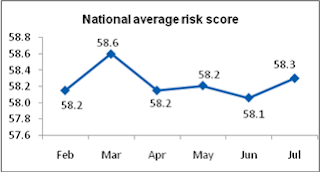
·  The average commercial risk score for July was 58.3, up 0.5 percent over June’s average score of 58. For firms with one to four employees, the risk score is 56.7, up 1.3 percent from six months ago.
Graphic provided by Experian


·  In July, very large businesses, which have more than 1,000 employees, showed an almost 6 percent drop in their risk scores compared with June, going from 41.6 to 39.3. However, these businesses continue to demonstrate the greatest overall improvement in risk scores when compared with six months ago, when the average score was 38.2.

· In July, public administration showed the biggest improvement in risk scores over the past six months, improving by 1.6 percent. Conversely, the financial sector showed the greatest decline in risk scores over the same six-month period, decreasing by 1.5 percent.

· Pennsylvania (61.4), Massachusetts (61.2) and Illinois (58.9) were the only states with the largest metropolitan areas that had risk scores better than the national average in July.


Average Days Beyond Terms (DBT):
· All industry groups have shown an increase in DBT in July compared with June. Manufacturing and Utilities had the biggest increases, rising by 2.5 percent and 2.4 percent, respectively.

Graphic provided by Experian


· New York (4.2 DBT), Massachusetts (5.1 DBT), Pennsylvania (5.3 DBT), California (5.4 DBT) and Texas (5.8 DBT) were the only states with the largest metropolitan areas that stayed well below the national average DBT in July. 

Sunday, August 29, 2010

DC Group Hosts Event to Help Small Firms Navigate How to Do Business in D.C.

The Washington DC Economic Partnership, a group that helps small businesses get business in the D.C. metro area, is hosting "Doing Business 2.0."

The event is the live version of its "Doing Business in DC" publication providing a step-by-step guide for entrepreneurs who want to start or expand a business in D.C.

The group has set up a panel discussion focused on each of the 10 chapters in its book. Topics range from starting up to business financing and speakers include academics, business executives, venture capitalists and others.

The event will be held Wednesday, Sept. 8 from 9 a.m. to 10:30 a.m. at Venable, 575 7th St., NW, Capitol Room, 8th Floor, Washington, 20004. Only a few spaces remain.


Monday, August 23, 2010

Charitable Groups Outpace Others in Use of Social Media


New research shows that charitable organizations are still outpacing the business world and academia in their use of social media.

The latest study looking at 2009 data (pdf) by The University of Massachusetts Dartmouth Center for Marketing Research revealed that 97 percent of charitable organizations are using some form of social media including blogs, podcasts, message boards, social networking, video blogging, wikis and Twitter.

The analysis is based on detailed interviews with executives from 76 of 200 charities that responded to the researchers' requests. They were working off a list of 200 of the nation's largest charities as identified by Forbes magazine.

The charities that participated in the study are diverse in mission, average gifts and total revenue. They include some of the best-known charities in the country such as the Salvation Army, American Heart Association, Catholic Relief Services, Dana-Farber Cancer Institute and American Lung Association.

The participating non-profits are geographically diverse with headquarters in most major U.S. cities including New York, Washington, Chicago, Boston, Atlanta and San Francisco.

The researchers issued their first study on this subject and showed that these large non-profits were leading large and small businesses as well as universities in their familiarity with, usage of, monitoring of and attitude towards social media. That trend continued in 2008 and 2009.

IRS Aims to Boost Electronic Transactions


The IRS has just issued proposed regulations to significantly increase the number of electronic transactions between taxpayers and the federal government.

The proposed regulations (REG 153340-09) would eliminate the rules for making federal tax deposits by paper coupon because the paper coupon system will no longer be maintained by the Treasury Department after Dec. 31, 2010.

The proposed regulations maintain existing rules for depositing federal taxes through the Electronic Federal Tax Payment System.

The IRS says that using EFTPS to make federal tax deposits provides substantial benefits to both taxpayers and the government, i.e., EFTPS users can make tax payments 24 hours a day, seven days a week from home or the office.

The system also allows taxpayers to schedule dates to make payments even when they are out of town or on vacation when a payment is due.

Information on EFTPS, including how to enroll, can be found at www.eftps.gov or by calling EFTPS Customer Service at (800) 555-4477.

Thursday, August 19, 2010

When Disaster Strikes

I recently drove through 80 mile an hour winds with a six year old in the car. We pulled over, and then drove some more as trees started falling around us, lightening stunning our vision. Our car lifted off the ground, set down again. Power lines were loose and flying everywhere.

Luckily, the storm ceased and we were fine. Our neighborhood was without power for three days, others went without longer. I can live without air conditioning, but it was difficult to have no refrigeration and frankly I wish I could have done laundry. As a freelancer, I also have a home office, highlighting for me the importance of good storage and the need to find backup places to go to get work done.


I felt so lucky compared to the home owners of some of the houses we drove by when the storm was over. Trees had snapped houses in two. Huge trees were uprooted everywhere. We saw one hanging upside down from the telephone wires. A friend’s house was condemned after two trees fell on it. She had to move her family, including her four kids to a rental. These disasters are nothing compared to what’s going on in Pakistan and elsewhere, but it’s home. 

Another neighbor complained that with our unusual blizzards last winter, freak tornadoes this summer, “Bring on the zombies! At this point, I’m definitely ready for zombies!” Don’t speak too soon – Halloween is around the corner.


I started thinking about my experience last week, sawing and hauling trees when I read a government report today about federal funds needed after hurricanes Katrina and Rita. Today many small businesses in the Gulf Coast still face recovery challenges from those tragedies – and now they’re reeling from the oil spill.

The Small Business Administration provided about $1.4 billion in loans after those hurricanes, in addition to monies provided by Louisiana and Mississippi. The GAO recently interviewed some of those small business loan recipients and found that some of the business owners had problems applying for SBA loans because the hurricanes destroyed needed financial records. I hope most small firms are getting on board with cloud computing so they’re not storing their best data on site. If you don't know what that is, there's probably someone at your local chamber of commerce who does. At the very least, get a fire and water proof box.

“Other owners face higher expenses, especially the cost of commercial insurance and added debt from these loan programs, which has made recovering difficult,” the GAO found.

Meanwhile, Gulf Coast small businesses received almost $2.9 billion in federal contracts awarded in response to the hurricanes. The GAO also found that two of the agencies awarding the most in federal contracts for hurricane recovery couldn’t demonstrate they were monitoring subcontracting accomplishment data for 13 of 43 construction contracts. Trust me, people want things built well.

The report also found that populations and the number of small businesses in heavily damaged areas increased, but both are still below prehurricane levels.

“The impact of the recent oil spill in the Gulf of Mexico on small businesses is uncertain,” the report cautioned.


Wednesday, August 18, 2010

New Health Care Bill Befuddles Micro Business Owners


When it comes to the health bill, small business owners are wondering if they should take two aspirin – but who the heck to call in the morning?

Micro-businesses, which have fewer than 10 employees, are confused whether their health plans meet certain requirements outlined in the Affordable Care Act, according to a new study.

The bill offers entrepreneurs the choice to keep the plan they currently provide – if it meets certain requirements – but most entrepreneurs are uncertain how their plan will meet these new rules and if their monthly premiums will be affected, according to a survey by the National Association for the Self-Employed. Some study highlights:

·         65 percent of micro-businesses say they only somewhat or slightly understand the new "grandfathered" plan requirements and how it may impact their ability to keep their plans.
·         Of those aware of the requirements to maintain "grandfathered" status of a health plan, 43 percent believe they can keep their plan. Fifty-seven percent were either unsure or knew that they would not be unable to keep their current plan.
·         92 percent believe the self-employed and small business owners should receive a notice from their insurer or from the federal government about whether their plan qualifies as a “grandfathered” plan

With close to 50 percent of micro-business respondents wishing to keep their current coverage, a clear understanding of the “grandfathered” status regulations will be essential to a small-business owner’s ability to maintain their existing coverage, says NASE.

“The self-employed and micro-businesses are always looking at how to get the best deal and health coverage is no exception,” said Kristie Arslan, executive director of NASE’s legislative offices. “Our concern with the current 'grandfathered' status regulations is that it leaves business owners with little wiggle room to make key adjustments to their existing health plan to maintain its affordability for the business owner and employees. Ultimately, micro-businesses will be forced to drop their plan they were hoping to keep and be pushed into the new insurance market which is likely to offer more robust, but also more expensive health plans.”

NASE’s survey found that approximately 67 percent of respondents have changed insurance carriers since the inception of their business, with 55 percent indicating that the primary driver for the change corresponded with the desire to find a better deal or lower costs. Many who made adjustments to their existing health plan to address costs did so by adjusting their deductibles – a move that, under proposed rules, would force them to lose their “grandfathered” status.